




For decades, follicular lymphoma has been described in textbooks as “not curable.” Yet today, that long-standing narrative is being challenged by a wave of breakthrough therapies, including CAR T-cell therapy and bispecific antibodies, which are delivering unprecedented response rates for patients with relapsed or refractory disease.
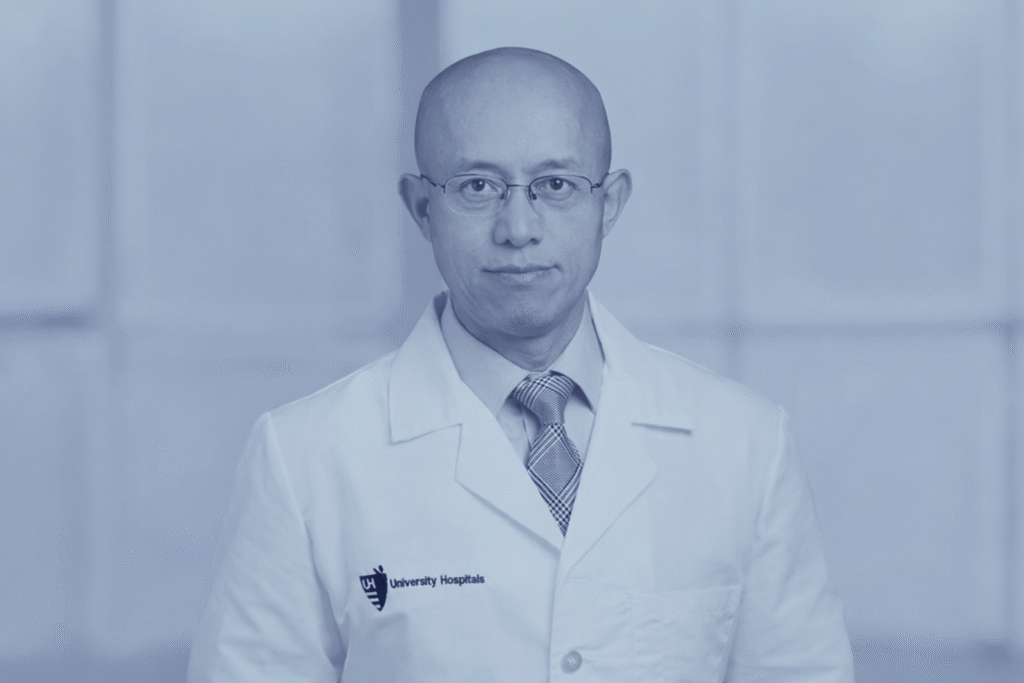
Dr. Changchun Deng, associate professor at Case Western Reserve University School of Medicine, director for lymphoma and chronic lymphocytic leukemia, and a physician at the Seidman Cancer Center of University Hospitals in Cleveland, sees this shift firsthand. Deng recently told SurvivorNet, “I’m an optimist. I definitely see on the horizon that the cure is coming.”
Deng and a team of researchers have conducted CAR T and other significant cell therapy research in recent years at Seidman’ Wesley Center for Immunotherapy at UH. But while scientific progress is accelerating, Deng says access to these innovations remains uneven, particularly for patients treated outside major academic cancer centers.
Background: A New Era of Immunotherapy
Much of the excitement centers around immunotherapies. Bispecific antibodies, for example, are engineered with two targeting mechanisms. “One is targeting the tumor antigen so they know where to go,” Dr. Deng explains. “The other one has the CD3 targeting antibodies so they can bring and activate the T-cells. Then the T-cells can attack the lymphoma cells right where the disease is.” Deng says these therapies, including FDA-approved CD20-CD3 agents such as epcoritamab and mosunetuzumab, have “markedly improved” complete response rates and progression-free survival in relapsed follicular lymphoma.
Deng says CAR T-cell therapy may represent an even more dramatic leap forward. “For fit patients, the CAR T-cell therapy probably gives us the best chance of actual long-duration response, meaning more than five years,” Dr. Deng says. “There are some patients in early trials already beyond five years.” Historically, follicular lymphoma was considered incurable. Now, he adds, CAR T-cell therapy “will have the chance to really deliver cure.”
The Access Divide
Despite this progress, not every patient has access to these advanced treatments. “This is a large country,” Dr. Deng notes. “We have a lot of patients who, from either medical, social, or geographic reasons, cannot have access to either bispecific antibody or CAR T-cell therapy or transplant.” CAR T therapy, in particular, requires specialized centers with the infrastructure to manage manufacturing timelines, potential toxicities like cytokine release syndrome, and complex coordination of care. Many community oncology practices simply do not have these capabilities onsite.
Even bispecific antibodies, while “off-the-shelf”, often require careful monitoring during early treatment cycles, something more readily available at academic centers. The result, says Deng, is a serious treatment gap: patients in major metropolitan areas with large cancer centers may have access to cutting-edge clinical trials and immunotherapies, while those treated primarily in community settings may rely more heavily on traditional chemo regimens.
Practical Solutions to Close the Gap
Dr. Deng believes the solution lies fundamentally in stronger integration between academic and community oncology. At University Hospitals, the system includes multiple satellite sites closely tied to the main academic center. “We will inform [community oncologists] of the clinical trials,” he says. “We’ll get their patients enrolled in trials that don’t require intense traveling for monitoring. We can start those patients, and then subsequently they can return to their community base.” This “hub-and-spoke” model allows patients to receive specialized therapies at the academic center during critical early phases, and then transition back to local care.
In regions where integration is less developed, Dr. Deng recommends expanding clinical trials into community settings. “One idea will be to facilitate clinical trials, especially those in late-phase development, in those community sites,” he says, “and then encourage community doctors to participate.”
Deng also emphasizes that highly effective regimens such as tafasitamab (Monjuvi) combined with lenalidomide and rituximab represent accessible options for patients who are not candidates for CAR T or cannot travel. “In the community setting,” he says, this combination “will be very appropriate… one of the easiest and still highly effective regimens for patients in the relapse setting.”
A Future Within Reach
Ultimately, Dr. Deng envisions a future where bispecific antibodies move into first-line treatment, potentially reducing or even eliminating the need for chemotherapy, and CAR T-cell therapy serves as a curative option at relapse. “Imagine in another two, three years,” he says, “we could give a bispecific antibody in the first line… and then cure another majority of those patients with a CAR T-cell therapy.”
For now, the science is advancing rapidly. The challenge is ensuring that geography does not determine outcome. “The prospect is very bright,” Dr. Deng says. “I hope all patients with follicular lymphoma will do really well and take advantage of the opportunities, especially clinical trials, so they can get the most advanced treatment.” Closing the access gap, he suggests, is not just a logistical challenge. It’s a moral imperative and a necessary step toward making the promise of cure a reality for every patient, not just those living near a major cancer center.

